
| S.N | Mode | Route | Elev.(m) | Duration | Overnight | Included |
|---|---|---|---|---|---|---|
| 1 | Flight | Arrival Kathmandu Tribhuvan Int'l Airport - Tranfer Hotel | 1300 | Hotel | Breakfast | |
| 2 | Tour | Namo Buddha Monastery | 5/6 Hours | Hotel | Breakfast | |
| 3 | Tour | Day Tour - Pharping Gompa (Monastery) - Kritipur Monaster | 5/6 Hours | Hotel | Breakfast | |
| 4 | Tour | Swoyambhu Monastery - Buddha Park - Drubgon Jangchup Choeling Monastery | 4/5 Hours | Hotel | Breakfast | |
| 5 | Tour | Patan Durbar Square - Buddhist Pilgrimage - Day Tour | 5/6 Hours | Hotel | Breakfast | |
| 6 | Tour | Kopan Monastery - Shechen Monastery - Boudhanath Stupa (Monastery) - Farewell Dinner | 5/6 Hours | Hotel | Breakfast | |
| 7 | Flight | Departure - Kathmandu Tribhuvan Int'l Airport - Own Your Destination | Breakfast |
Key Aspects of Kathmandu Buddhist Pilgrimage Tours
Kathmandu offers a rich Buddhist pilgrimage experience, featuring numerous sacred sites deeply tied to the spiritual heritage of Buddhism. Various Buddhist pilgrimage tours in Kathmandu provide an opportunity to explore these ancient landmarks, meditate in serene monasteries, and gain deeper insights into Buddhist teachings.
Namobuddha Monastery – Situated on a serene hill, this monastery marks the legendary spot where a former life of the Buddha sacrificed himself to feed a hungry tigress and her cubs.
Pharping Monastery – A sacred site associated with Guru Rinpoche (Padmasambhava), featuring meditation caves and a monastery where many Buddhist practitioners train.
Swayambhunath Stupa (Monkey Temple) – An ancient stupa perched on a hilltop with stunning views of the Kathmandu Valley. It is believed to be one of the oldest Buddhist sites in Nepal.
Patan's Mahabouddha Temple – Known as the "Temple of a Thousand Buddhas," it is an artistic masterpiece inspired by the Mahabodhi Temple in Bodh Gaya, India.
Kopan Monastery – Located on a peaceful hilltop, this monastery is known for meditation retreats, spiritual teachings, and interaction with monks.
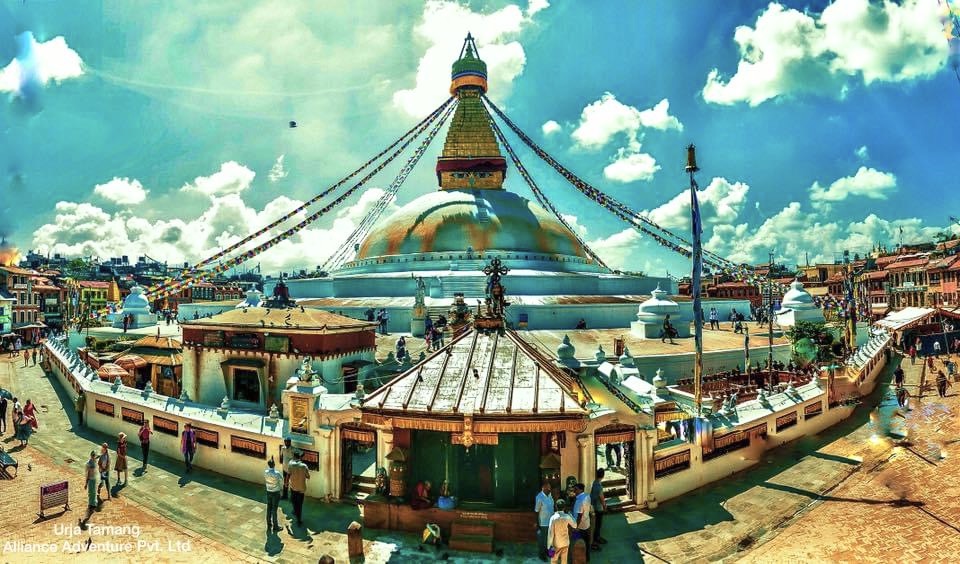
Boudhanath Stupa – One of the largest stupas in the world and a UNESCO World Heritage Site, this iconic structure is a major pilgrimage destination where devotees perform kora (ritual circumambulation) while spinning prayer wheels.
 7 Days
1300 m.
7 Days
1300 m.
 Breakfast
 Hotel
Hotel
Welcome! Upon your arrival at Kathmandu Tribhuvan International Airport, you'll be greeted warmly by our representative holding a sign with your name for easy identification. You'll be welcomed with a traditional Nepali culture by flower garland as a gesture of good will and blessing.
Our friendly team will assist you with your luggage and ensure a smooth transfer to your hotel in the heart of Kathmandu. Along the way, you'll get a glimpse of the city's vibrant streets, bustling with energy and charm.
Once at your hotel, you'll be helped with the check-in process. Afterward, you can relax and enjoy a refreshing welcome drink as you settle into the serene ambiance of your accommodation.
Before check in your room Alliance adventure will brief you about your Buddhist Pilgrimage Tour with offering you nepali tranditional Dinner
7 Days
Breakfast
Hotel
Namo Buddha, is one of the most sacred Buddhist pilgrimage sites in Nepal. It is revered for its association with the Bodhisattva of Compassion and houses prominent monasteries (gompas) dedicated to Buddhist teachings and meditation. The history of Namo Buddha is rooted in an ancient legend and the region's rich Buddhist heritage and according to Buddhist lore, Namo Buddha is the site where a Bodhisattva, in one of his previous incarnations, demonstrated extraordinary compassion. The story goes that a young prince named Mahasattva (an incarnation of Buddha) encountered a starving tigress and her cubs near this site. Moved by their plight, he offered his body as sustenance, sacrificing himself to save them. It is believed that a stupa (reliquary monument) at Namo Buddha enshrines the remains or relics of the prince, making it a highly sacred site for Buddhists.
7 Days
Breakfast
Hotel
Pharping Gompas are Buddhist monasteries located in the peaceful and spiritually significant town of Pharping, situated south of Kathmandu, Nepal. Pharping is a key pilgrimage site for Tibetan Buddhists and is revered for its ancient monasteries, caves, and spiritual ambiance. Pharping is believed to be the place where the great 8th-century Buddhist master Padmasambhava (Guru Rinpoche) attained enlightenment. The area is often considered equivalent to Bodh Gaya in India, making it a vital pilgrimage destination for Buddhists. Pharping is significant in both Hinduism and Buddhism, with temples, monasteries, and caves that attract followers of both religions.
Keys of Pharping Gompas: Asura Cave (Asura Gompa) - Yangleshö Cave - Neydo Tashi Choling Monastery - Pema Ösel Ling Monastery - Sangdo Palri Monastery
Kritipur Monastery - (Kagyu Institute of Buddhist Studies) was initially only a small house on an open field, built by devotees of His Holiness the 16th/17th Karmapa and offered to His Holiness when he first visited Nepal. Since then, His Holiness had appointed lamas from Mendong Monastery to run the Kirtipur Monastery. Kirtipur Monastery played an important role in being the sanctuary for many high lamas to complete their spiritual practices, it has also been an important source of spiritual guidance, teachings, empowerments and inspiration to countless lay devotees.
7 Days
Breakfast
Hotel
Swayambhunath Stupa, often referred to as the Monkey Temple, is one of the most iconic and sacred religious sites in Nepal. Located atop a hill in the western part of Kathmandu, it holds immense significance for both Buddhists and Hindus. This UNESCO World Heritage Site is known for its ancient architecture, spiritual ambiance, and stunning views of the Kathmandu Valley. Swayambhunath is believed to date back to at least the 5th century CE, making it one of the oldest religious sites in Nepal. According to legend, the Kathmandu Valley was once a vast lake, and a lotus grew from its center. The stupa marks the spot where the lotus settled after the water drained, with "Swayambhu" meaning "self-created" or "self-existent." The stupa is tied to the legend of Manjushri, a bodhisattva who drained the lake by cutting a gorge at Chobar with his sword, making the valley habitable. The site exemplifies the syncretism of Hinduism and Buddhism in Nepal, with Hindu deities like Saraswati and Shiva worshipped alongside Buddhist figures
Buddha Park, is a serene Buddhist site featuring three large golden statues of the Buddha and two important Bodhisattvas: Shakyamuni Buddha, Avalokiteshvara (Chenrezig), and Guru Rinpoche (Padmasambhava). It is located near Swoyambhunath Stupa (also known as the Monkey Temple), one of Nepal's most sacred Buddhist sites.
Drubgon Jangchup Choeling Monastery, is a significant Buddhist monastery located in the famous Kathesimbhu Stupa, it is very near from Thamel. The monastery is known for its vibrant decorations, prayer wheels, and peaceful atmosphere, attracting both local devotees and international visitors. It is part of the Swayambhunath Complex, which is one of the most important Buddhist heritage sites in Nepal.
The monastery is an integral part of the cultural and spiritual landscape of Kathmandu, offering a serene space for meditation and religious activities. It is situated in a square alongside numerous statues, a school, and other Buddhist structures, making it a hidden treasure amidst the bustling city.
7 Days
Breakfast
Hotel
Ratnakar Mahavihar, also known as Ha Baha, is a significant Vajrayana Buddhist monastery in Patan Durbar Square. This vihara has deep historical and cultural importance, particularly within Newar Buddhism. It is one of the many monastic complexes (bahas and bahis) that define Patan’s religious and architectural heritage.
The history of Ratnakar Mahavihar dates back to the Licchavi period, which was a golden age for Buddhism in Nepal. The monastery played a crucial role in preserving and practicing Buddhist rituals, art, and traditions. It is especially known for its association with the Kumari tradition of Patan, as it is the official residence of the Kumari of Patan, a living goddess in Newar Buddhist culture.
Hiranya Varna Mahavihar, commonly known as the Golden Temple, is a significant Buddhist monastery in Patan It is one of the most important historical and cultural sites in the Kathmandu Valley. The monastery, also known as Kwa Baha, was built in the 12th century by King Bhaskar Verma and later renovated by King Yaksha Malla in the 15th century. It underwent extensive restoration in the 20th century.
The temple is famous for its golden facade, which features intricate carvings and detailed decorations. Inside, there is a large central courtyard surrounded by smaller prayer halls and shrines. The temple houses a solid gold statue of Shakyamuni Buddha, believed to be one of the largest of its kind, showcasing the skill and craftsmanship of Nepalese artisans.
A unique feature of the temple is the upper-level chapel, which is dedicated to an eight-armed Avalokiteshvara. The courtyard also contains statues of four Lokeshvaras (incarnations of Avalokiteshvara) and four monkeys holding jackfruits as an offering.
Maha Buddha Temple, also known as Mahabuddha Temple or the "Temple of Ten Thousand Buddhas," is a historic Buddhist temple located in Patan Durbar Square. It was built in 1601 as part of Uku Bahal Monastery and is said to be inspired by the Mahabodhi Temple in Bodh Gaya, India. The temple's construction was initiated by Abhaya Raj, a priest who visited Bodh Gaya in the 1560s and was deeply influenced by its architecture. Although he passed away before completing the temple, his descendants finished the project under the rule of the Malla dynasty.
7 Days
Breakfast
Hotel
Kopan Monastery, located on a hill north of Boudhanath Stupa, is a renowned center for Tibetan Buddhist studies and meditation. The monastery was founded in 1969 by Lama Thubten Yeshe and Lama Zopa Rinpoche as a place for monks to study and practice the teachings of the Gelug school of Tibetan Buddhism. It has since become an important destination for spiritual seekers from around the world.
The site of Kopan Monastery was originally the residence of the King of Nepal’s astrologer before being acquired by the founders. The first temple was built in 1971-72 with funding from Western disciples of the Lamas. Early monks at Kopan came from regions such as Solu Khumbu and Manang in Nepal, and the monastery played a crucial role in re-establishing Buddhist teachings outside of Tibet after the Chinese invasion in 1959.
Kopan Monastery expanded significantly. Today, it houses hundreds of monks and nuns and offers extensive Buddhist courses for both monastics and laypeople. Its annual month-long meditation course, which started in 1971, continues to attract participants from all over the world. The monastery is also famous for its serene environment, stunning views of the Kathmandu Valley, and its role in bringing Tibetan Buddhist philosophy to a global audience.
Shechen Monastery, is one of the most important monastic centers of the Nyingma tradition of Tibetan Buddhism. Originally founded in 1734 or 1735 by the Second Shechen Rabjam, Gyurme Kunzang Namgyal, in the Derge region of Kham, Tibet, it became one of the six main Nyingma monasteries. It was known for its rich tradition of sacred arts and philosophy and developed a network of around 160 satellite monasteries across the Himalayan region.
After the destruction of the original Shechen Monastery in Tibet during the Chinese Cultural Revolution, the monastery was re-established in 1980 in Boudhanath, Kathmandu, Nepal, by Kyabje Dilgo Khyentse Rinpoche. This new monastery, called Shechen Tennyi Dargyeling, was built with great attention to detail to preserve the artistic heritage of the original monastery. It houses a significant Tibetan library, the Tsering Art School, and a Buddhist philosophical college (shedra), where over 300 monks receive training in philosophy, ritual arts, music, dance, and meditation.
Boudhanath Stupa, also known as the Buddha Eye Stupa, is one of the largest and most significant Buddhist stupas in Nepal. It is a UNESCO World Heritage Site and a major pilgrimage destination for Tibetan Buddhists. The stupa’s rich history, religious importance, and architectural grandeur make it a symbol of Nepal's cultural and spiritual heritage.
Boudhanath Stupa, dates back over 1,500 years. It was originally constructed in the 5th century during the reign of the Licchavi King Mandev. According to legend, King Mandev built the stupa as an act of penance for mistakenly killing his father. Another story credits a poultry-keeper widow named Jyajima and her four sons with constructing the stupa after receiving permission from the king.
After this pleasant Kathmandu Worlds Heritage City Tour, Alliance Adventure offer you Nepali typical culture dinner.
7 Days
Breakfast
Departure to Kathmandu Tribhuvan Int'l Airport after a wonderful Nepal Buddhsim Pilgrimage Tours. Today is last day in Nepal and last minutes shopping for family's, frineds, packing and Alliance Adventure departure to the airport for your onward destination to your country.

100% Response Rate

9 Days
USD 1300 1099

7 Days
USD 715 550

7 Days
USD 715 595


© 2011 - 2024 All rights reserved.Alliance Adventure Pvt. Ltd. Developed By : Xenatech Nepal

